
🔄 Last updated: April 18, 2026
This Zoho Inventory vs Tally small retail comparison is based on testing both in my real grocery store — 800–1,200 SKUs in Hisar. I’ve used TallyPrime for accounting since 2019 and Zoho Inventory for stock management for over a year. Honest verdict: no fluff, no affiliate-driven rankings.
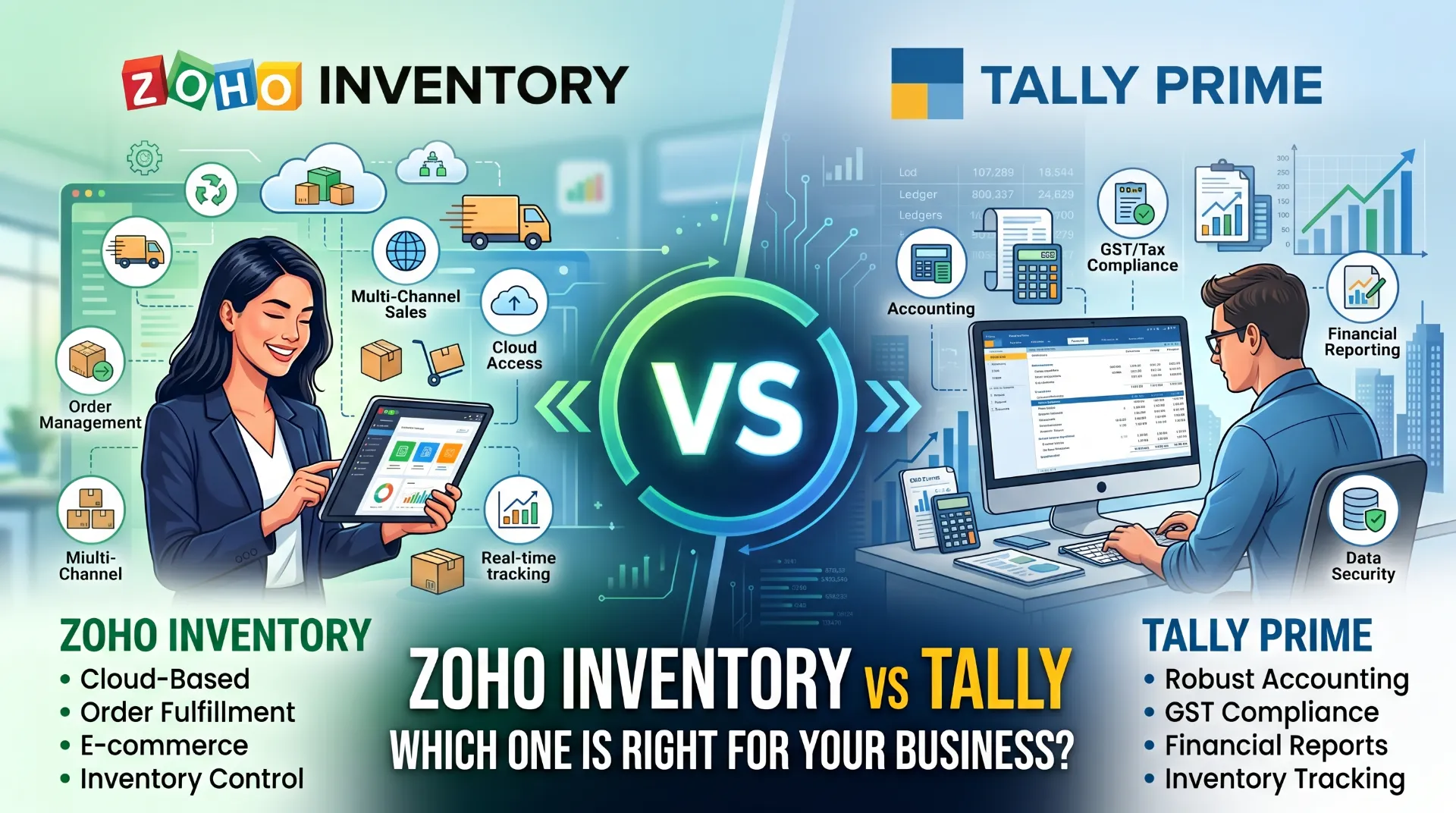
Zoho Inventory vs Tally for Small Retail (2026) — Tested in a Real Grocery Store
Zoho Inventory vs Tally — which is better for a small retail or grocery store?
Zoho Inventory wins for daily stock operations — batch-level expiry tracking, reorder automation, free mobile app, and a free API for custom alerts. Free plan: 50 orders/month, 1,000 SKUs, ₹0/month. Tally wins for accounting — deep GST compliance, P&L, offline reliability, CA-preferred workflow. For a solo grocery store owner managing stock themselves, Zoho solves the higher-cost problem (waste and stockouts). Most stores, including mine, run both simultaneously for different purposes at ₹0 extra monthly cost.
My CA called me last month with a question I didn’t expect. “Rahul bhai,” he said, “your GST returns are clean, but your inventory reconciliation is a mess. You’re using Tally for accounting and something else for stock — why not just use Tally for everything?”
I’ve been running gharstuff.com since 2019. For years Tally was Old Reliable — the same software every kirana shop in Hisar uses. But when we hit 1,200 SKUs and perishables started expiring faster than I could track them, Old Reliable started feeling old. My CA’s question made sense: why run two systems when Tally could theoretically handle both?
The answer took 12 months of actually using both to figure out. Those blogs comparing feature lists won’t tell you what happens when Vishal needs to check an expiry date during the morning rush, or what it costs when you want automated reorder alerts without paying ₹15,000 for a TDL customization developer. This comparison is different.
📚 What’s in this comparison
Quick Verdict — Before You Read Further
✅ Zoho Inventory wins for
Perishable & expiry tracking · Cloud access from phone · Free tier that’s actually usable · Reorder automation · Easy team access · API for Python scripts
✅ Tally wins for
Deep GST accounting & compliance · Desktop power users · CA-preferred workflow · Detailed financial reports · Full offline reliability
One-line recommendation: Use Zoho Inventory for stock management + Tally for accounting. They solve completely different problems. Many stores including mine run both at ₹0 extra monthly cost.
If you want to try what I use: Zoho Inventory free plan — the free tier covers most small stores at ₹0/month, and new users get $100 in Zoho Wallet credits.
Why Most Zoho vs Tally Reviews Are Misleading
Most comparison blogs — including several that rank on page one right now — treat Zoho Inventory and Tally as direct competitors in the same category. They score them on the same feature checklist, add up points, and declare a winner.
This framing is wrong, and it leads thousands of small retail owners to make the wrong decision. Here’s why: Tally is accounting software that includes basic inventory features. Zoho Inventory is inventory management software that requires separate accounting. Comparing them directly is like comparing a kitchen knife to a food processor — yes, both cut food, but they solve completely different problems at different points in your day.
The review sites comparing them side-by-side are also predominantly written by content marketers who’ve never managed 800 perishable SKUs under daily time pressure. What they describe as a “minor limitation” — like Tally’s lack of automated expiry alerts — cost me roughly ₹5,000/month in preventable waste until I stopped relying on Tally alone for inventory.
This comparison is built around a different question: not “which tool is better” but “which problem are you solving, and which tool is right for that problem.” The answer might be both.
What Zoho Inventory and TallyPrime Actually Are
TallyPrime — India’s Accounting Standard
TallyPrime is a desktop-first accounting software used by an estimated 70–90% of India’s MSME businesses. It handles core accounting, GST filing, TDS/TCS, e-invoicing, payroll, and basic inventory tracking. The interface is keyboard-driven — fast for experienced users but a steep learning curve for non-accountants. Your CA almost certainly knows it already and probably prefers it.
What Tally is not: a modern inventory management system built for operational daily use. It lacks automated reorder alerts, a usable API for custom automation, a mobile app your counter staff can check during a busy morning, and the kind of batch-level expiry management a grocery store with 800+ perishable SKUs genuinely needs.
Zoho Inventory — Cloud-Native Stock Management
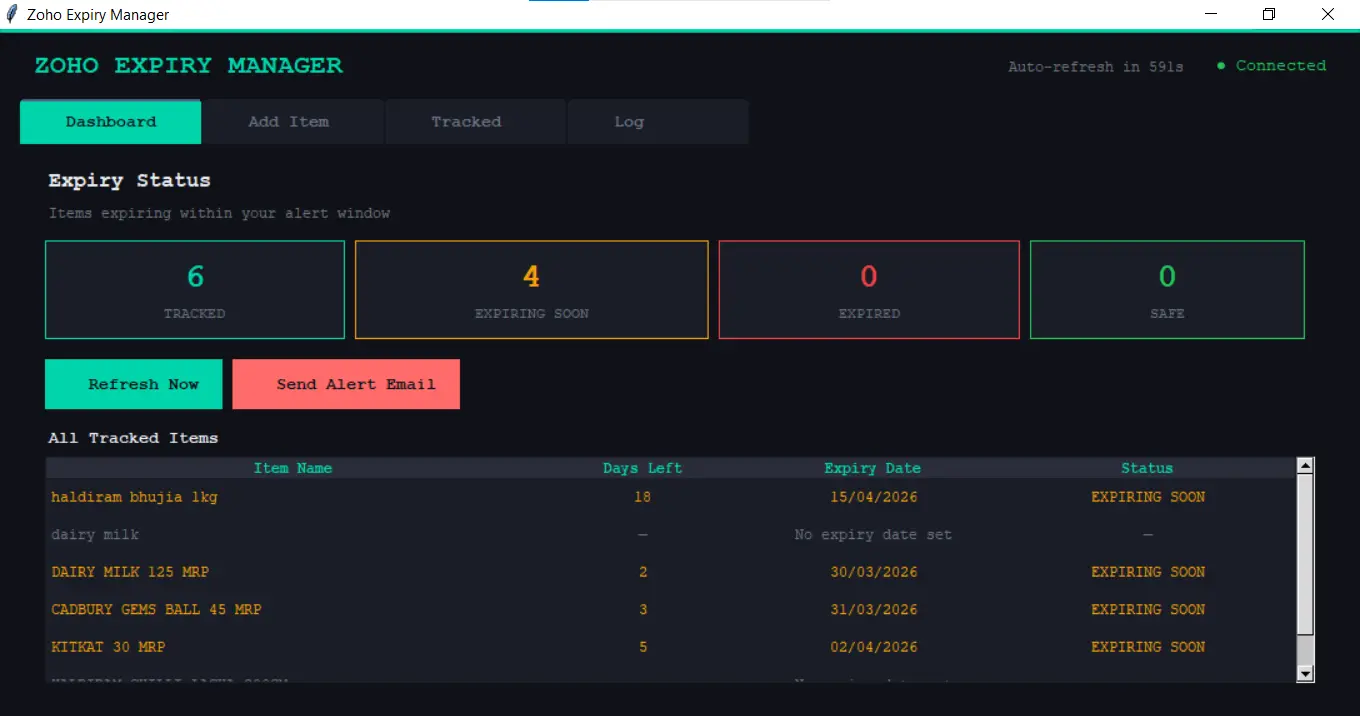
Zoho Inventory is cloud-based inventory software built for real-time tracking, expiry alerts, reorder points, purchase orders, and multi-channel sales. It integrates natively with Shopify and Amazon, and offers full API access for custom automation — which is how the Python expiry alert script I built works on the free plan at zero cost.
What Zoho Inventory is not: full accounting software. For double-entry accounting and GST return filing, you need Zoho Books or Tally alongside it. Zoho Inventory tells you what’s on your shelves and what’s about to expire. It doesn’t file your GST returns.
💡 The core difference in one sentence: Tally tells your CA what happened last quarter. Zoho Inventory tells you what’s about to expire on your shelves tomorrow morning.
Which Problem Are You Actually Trying to Solve?
Before comparing tools, identify your actual pain point. The answer determines everything.
📊 Pain Point A — Accounting & compliance
- GST returns are taking too long
- P&L isn’t clear month to month
- Invoice generation is slow
- CA finds your books hard to work with
- Tax reconciliation is a mess
→ This is a Tally problem
📦 Pain Point B — Stock & inventory
- Products expire before you sell them
- You run out of stock without warning
- Can’t check inventory from your phone
- Reordering is based on guesswork
- Waste is eating into your margin
→ This is a Zoho Inventory problem
For a grocery store with perishables, Pain Point B costs more money. A missed expiry date on 5kg of paneer costs ₹450 directly — today. A slightly slower GST filing costs 30 minutes once a month. Most small retail owners asking “Tally or Zoho?” are actually asking the wrong question — they need to fix inventory first, accounting second.
Pricing — What You’ll Actually Pay (April 2026)
Most Tally users don’t realise how the pricing model works across years, or what the real comparison looks like when you add everything up.
| Plan | TallyPrime | Zoho Inventory |
|---|---|---|
| Entry / Single User | Silver: ₹750/mo rental OR ₹22,500 one-time + ₹4,500/yr TSS renewal | Free: 50 orders/mo, 1,000 SKUs, 1 user — ₹0 forever |
| Multi-User / Upgraded | Gold: ₹2,250/mo rental OR ₹67,500 one-time (unlimited LAN users) | Standard: ~$39/mo (~₹3,200/mo) — 1,500 orders, 3 users |
| Hidden costs | TDL customization: ₹5,000–25,000 per feature; TSS mandatory for GST updates | Add-on integrations; overage fees if exceeding order limits |
| Year 1 effective total | ~₹27,000 (Silver + first year TSS) | ₹0 (free plan) |
⚠️ The TSS trap most Tally reviews skip: From year two, renewing TSS costs ~₹4,500/year for Silver (₹13,500 for Gold). Without TSS renewal, your software keeps working — but you won’t receive GST law updates, e-invoicing changes, or compliance patches. In India, GST regulations change regularly. Skipping TSS is a real compliance risk, not a theoretical one.
Here’s the calculation that changed how I think about this: using Tally for both accounting and full inventory management at my store would have required Tally Gold (₹67,500) plus custom TDL development for expiry alerts (₹8,000–15,000) = ₹75,000–82,000 in the first year. The dual setup — Tally Silver (₹22,500 one-time) + Zoho Inventory free (₹0/month) — cost ₹22,500 total. That’s a ₹50,000–60,000 saving, and Zoho’s expiry automation is better than what TDL customization would have delivered anyway.
Full Comparison — Zoho Inventory vs TallyPrime for Small Retail
| Feature / Need | Zoho Inventory (Free) | TallyPrime Silver |
|---|---|---|
| Starting cost | ₹0/month forever | ₹22,500 one-time or ₹750/mo rental |
| Mobile app | ✅ iOS + Android — full access | ❌ No official mobile app |
| Expiry date tracking (batch level) | ✅ Built-in — automated alerts | ⚠️ Manual entry, no proactive alerts |
| Reorder point automation | ✅ Per SKU, automatic flag | ❌ Manual report required |
| API access (Python / automation) | ✅ 1,000 free calls/day | ❌ No usable API without TDL developer |
| Works fully offline | ⚠️ Cloud-first — needs internet | ✅ Full desktop offline operation |
| GST billing and compliance | ⚠️ Basic — use Vyapar or Tally alongside | ✅ Deep GST, e-invoicing, e-way bill |
| P&L, balance sheet, accounting | ❌ Not accounting software | ✅ Complete double-entry accounting |
| Non-accountant staff usability | ✅ Clean mobile/web UI — learned in a day | ⚠️ Keyboard shortcuts, needs accounting knowledge |
| Purchase order management | ✅ On free plan | ✅ Strong supplier tracking |
| Multi-location / godowns | ⚠️ Paid plans only | ✅ Multi-godown on all plans |
| CA / accountant compatibility | ⚠️ CAs less familiar with Zoho | ✅ India’s most CA-accepted software |
| Python expiry alert integration | ✅ Built on free API — works today | ❌ Requires ₹8,000–25,000 TDL developer |
| Best for | Grocery/perishable retail, self-managed | Traditional trade, accountant-managed |
Zoho vs Tally in India — What’s Different Here
If you’re searching “Zoho vs Tally India,” you’re probably asking this because India has specific requirements that change the comparison: mandatory GST compliance, UPI payment dominance, a CA ecosystem almost entirely built on Tally, and a price sensitivity that makes Zoho’s free plan especially relevant.
Here’s what the India context changes specifically:
GST compliance: TallyPrime was built for Indian GST from day one. Every GST rule change — e-invoicing thresholds, HSN code requirements, new GSTR formats — gets patched into Tally via TSS updates. Zoho Inventory handles basic GST on invoices, but for serious GST filing, compliance, and CA review, Tally remains the Indian standard. This is the one area where Tally’s advantage in India is decisive.
CA relationships: In India, your CA is your practical compliance partner. 9 out of 10 Indian CAs work in Tally daily — they know its keyboard shortcuts, its report formats, its quirks. Asking your CA to switch to Zoho Books for your accounting is asking them to relearn their workflow for one client. The dual-system setup (Zoho Inventory for stock, Tally for accounting) avoids this entirely: your CA never touches Zoho.
Internet reliability: Zoho Inventory is cloud-first. In metro areas with stable fibre or 5G, this isn’t an issue. In semi-urban areas like Hisar, or in smaller towns, internet outages are a real operational risk. Tally’s offline-first model is genuinely valuable when your connection drops during the morning rush. Zoho does have a mobile app that caches some data, but it’s not designed for extended offline operation.
Price reality: Zoho Inventory’s free plan covering 1,000 SKUs and 50 orders/month is genuinely usable for most small Indian kirana stores — especially those that have moved to a hybrid model where not every sale goes through the inventory system. Tally’s ₹22,500 one-time Silver cost is a meaningful investment for a first-year store, but it’s also a one-time cost with a strong track record.
Which One for Your Store — The Honest Decision Framework
Stop trying to find the “better” tool. Find the right one for your situation:
📊 Your CA insists on Tally
Use Tally for accounting. Pair it with Zoho Inventory free plan for stock management. The dual setup works seamlessly — they never conflict because they handle different domains.
📦 Perishables + expiry tracking are your daily headache
Zoho Inventory. Tally’s batch tracking requires you to run a manual report to check expiry. Zoho’s automated morning alert prevents waste before it happens. For a grocery store, this is the higher-value problem.
📴 Unreliable internet in your area
Tally wins on offline reliability. Use it as your primary system. Add Zoho Inventory when your internet is stable enough for daily cloud use.
🛒 You sell online (Shopify, Amazon) alongside your store
Zoho Inventory — native integrations with both platforms. Tally has zero e-commerce integration without expensive custom TDL development.
🤖 You want automation without hiring a developer
Zoho Inventory. The free API lets you build Python scripts for expiry alerts, reorder triggers, and WhatsApp broadcasts at zero cost. Tally requires a TDL-certified developer for any automation — typically ₹8,000–25,000 per feature.
💰 Tightest possible budget — zero monthly cost
Zoho Inventory Free (₹0) + Vyapar Free (₹0) = complete billing + inventory stack at ₹0/month. Add TallyPrime Silver one-time (₹22,500) when revenue allows — it’s a one-time cost, not monthly.
Real Results — What Changed After Adding Zoho Inventory
| Metric at gharstuff.com | Tally only (first 3 months) | Tally + Zoho Inventory (since then) |
|---|---|---|
| Near-expiry items caught per week | ~2 (manually spotted by Vishal) | ~14 (automated Python alert) |
| Monthly waste cost | ~₹15,000 ($180) | ~₹10,000 ($117) — 33% reduction |
| Stockouts per month | 11 (guesswork reordering) | 3 (reorder point automation) |
| Check stock without being in store | ❌ Not possible | ✅ Zoho mobile app, anywhere |
| Vishal uses it independently | ❌ Needs me or CA present | ✅ Mobile app — learned in one morning |
| GST filing quality | Excellent — CA handles in Tally | Excellent — CA still handles in Tally |
The honest picture: adding Zoho Inventory didn’t change the accounting side at all — Tally still handles that. What changed was the operational side — expiry visibility, stockout prevention, and Vishal’s ability to manage the store without me needing to be present. For the full waste reduction system and how the WhatsApp broadcast connects to it, the food waste reduction guide covers the complete picture.
What I Actually Run at gharstuff.com
The three-tool stack at gharstuff.com
TallyPrime Silver
Accounting & GST
Zoho Inventory Free
Stock & expiry tracking
Vyapar Free
Customer billing
TallyPrime Silver (₹22,500 one-time, paid once) handles accounting and GST filing — my CA uses it. Zoho Inventory Free (₹0/month) manages stock, batch expiry, and reorder points — I use it daily. Vyapar Free (₹0/month) handles customer billing via WhatsApp. Total ongoing monthly cost: ₹0.
This three-tool setup isn’t elegant — three separate systems instead of one. But it works: Tally keeps my CA happy, Zoho prevents ₹5,000+/month in waste, and Vyapar makes billing fast at the counter. I tested every “all-in-one” alternative I could find. None handled all three well at a price a small grocery store can justify.
For the full Zoho Inventory setup — including how to configure reorder points, expiry batch tracking, and the Python expiry alert script from scratch — the Zoho Inventory setup guide walks through the complete process step by step.
💰 New user bonus — Zoho Inventory
Sign up through this link and get $100 in Zoho Wallet credits — the free plan stays free, credits apply if you ever upgrade past 50 orders/month.
Try Zoho Inventory Free → Get $100 CreditsWhen Tally Still Makes Sense — The Honest Cases
✅ Use Tally if you
- Have a CA who prefers Tally (most do)
- Have complex GST (multiple GSTINs, manufacturing)
- Operate in an area with unreliable internet
- Run multiple godowns or warehouse locations
- Sell non-perishables (hardware, garments, electronics)
- Need payroll management alongside accounting
⚠️ Don’t rely on Tally alone for stock if you
- Manage your own stock without a daily accountant
- Sell perishables needing proactive expiry alerts
- Want to check inventory from your phone
- Want automation without a TDL developer
- Need counter staff to check stock independently
- Want to connect stock data to WhatsApp or other tools
For a full comparison of Zoho Inventory against Sortly as a stock management layer, the Zoho vs Sortly comparison covers that decision in detail. And for the full billing tool picture for India, the Vyapar review explains why it’s our free billing layer.
FAQs — Zoho Inventory vs Tally for Small Retail
Q1: Is Zoho Inventory or Tally better for a small Indian grocery store?
Q2: Can I use only Tally and skip Zoho Inventory completely?
Q3: Is Zoho Inventory really free for small Indian stores?
Q4: Does TallyPrime have a mobile app in 2026?
Q5: Which is easier for non-accountant staff?
Q6: Can I run both Zoho Inventory and Tally together?
Q7: Can I automate expiry alerts in Tally?
Q8: What if my CA refuses to work with Zoho?
📥 Free Toolkit — Zoho Setup Files + Python Expiry Alert
📥 Free Toolkit — Zoho Expiry Alert + Inventory Kit + ChatGPT Prompts
The Python expiry alert script that runs on Zoho’s free API every morning, the full AI Inventory Toolkit with reorder point calculator, AI Waste Tracker, ChatGPT prompt library (including all inventory prompts), and WhatsApp Broadcast Templates. All free.
Free. No spam. Unsubscribe anytime.
Final Verdict — Stop Trying to Pick a Winner
If you only remember three things from this comparison:
- Tally is accounting software that does basic inventory. It’s what your CA wants, reliable offline, and the right choice for GST compliance and financial reporting.
- Zoho Inventory is stock management software that needs separate accounting. It prevents waste, automates reordering, and lets you check stock from your phone — none of which Tally does well for a solo store owner.
- You don’t have to choose. The dual setup — Tally for accounting, Zoho for stock — costs ₹0/month ongoing (after Tally’s one-time licence) and gives you the best of both.
The real question isn’t “Tally or Zoho?” — it’s “what problem are you solving first?”
GST compliance and CA approval: Tally. Stockouts, expiry waste, and visibility from your phone: Zoho Inventory. Both matter for a grocery store: use both.
If you’re adding Zoho Inventory to your existing Tally setup: Zoho Inventory free plan — new users get $100 in Zoho Wallet credits. The free plan itself never expires.

About the Author
Rahul Saini
Grocery store owner in Hisar, India, running gharstuff.com since 2019 with 800–1,200 SKUs daily. I test AI tools in my real store — with real staff, real customers, and real consequences when something doesn’t work. Every number on this site is from my actual store.
Read My Full Story →Related Articles
Last updated: April 2026. TallyPrime pricing verified from authorised Tally partner sources, April 2026. Author: Rahul Saini, SmallRetailAI.com.
Are you on Tally and thinking of adding Zoho? Or running both already? Tell me in the comments — I read every one.
Great post! Thanks for sharing this valuable information. Keep up the excellent work.